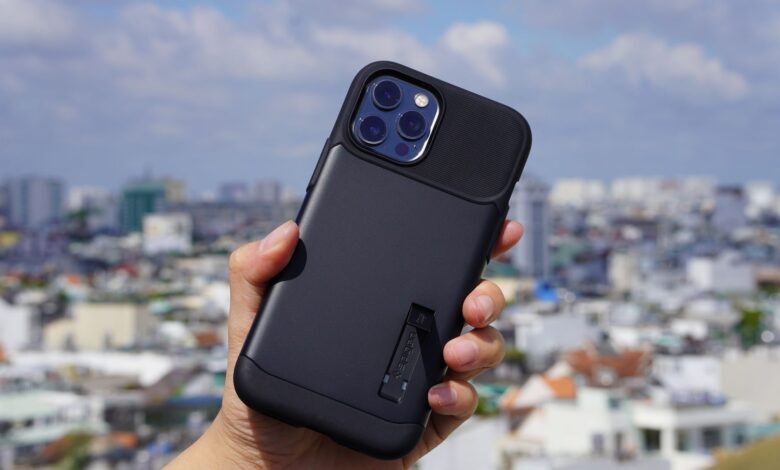
The best Spigen cases will vary based on the specific iPhone model you have, and what aspect of the iPhone annoys you most. Some of the things to consider are if you prefer a heavier phone in your pocket, slippery grip, clear back that discolor, or an accessory that requires magnets to work properly. Because there is no universal best iPhone case for everyone, you can compare the various cases based on the way each of them is constructed, how much added bulk they cause, if they have magnets built into them, and if they fit your iPhone.
To help with your choice of a Spigen case for your iPhone, you should understand three terms. The first term is “PC,” which refers to the hard polycarbonate used on the back of cases. The second term is “TPU,” which refers to the soft thermoplastic polyurethane generally used on the bumpers and front of the case. The final term is called “MagFit,” which is the name Spigen uses for its models that come with a built-in magnet ring. MagFit models are specific models only, and do not encompass the entire family of Spigen cases. For example, while you can find Rugged Armor cases with MagFit, the most current iPhone 17 Liquid Air listings do not have this designation anywhere within their descriptions. The Press Voice has also not performed its own drop or aging tests for their Spigen cases before publishing their results.
Which Spigen families you can actually buy now and what each is made of
The name of each Spigen case gives you a good indication of how it has been constructed. Each type of case has its own unique combination of materials and magnetic system based on which phone the case is designed for.
Ultra Hybrid combines a flexible bumper with a hard plastic back for support. Wirecutter describes its MagFit version of Ultra Hybrid as a clear hard plastic backing, with TPU edges and air-filled pockets that cushion your device in the event of a drop. Wirecutter has rated it as the best clear case for each of Apple’s current iPhone models.
Liquid Air provides a grippy and soft feel in the hand. According to Spigen, the iPhone 17 version of Liquid Air is made up of matte TPU and embossed textures along the sides of the case.
Liquid Air T (MagFit) is not simply a version of Liquid Air with a magnetic feature; it is a completely distinct product. The iPhone 16 Pro Max version of Liquid Air T is touted as “the thinnest Spigen case” and features a “stronger magnetic connection” than Liquid Air and other cases.
Thin Fit is the minimalist option. The iPhone 17 Thin Fit MagFit boasts raised edges and a cutout for the Camera Control Button.
Rugged Armor materials have changed across generations. The research record for the iPhone 14 listing shows a TPU build. The iPhone 16 MagFit listing shows impact foam inside. An iDropNews hands-on review found the iPhone 17 Pro version made of the same TPU and PC as Tough Armor T, just with less foam.
Spigen Tough Armor Cases are heavy-duty. For example, Spigen’s iPhone 14 Pro Max Tough Armor MagFit includes hard PC (polycarbonate), flexible TPS (thermoplastic rubber), impact-foam material, and an integrated kickstand.
Table 1 ranks each case family based on different measurements. “Protection Features” indicates protective design features (i.e., listed by Spigen); whereas “Bulk” indicates weight and thickness (measured or listed). The “Magnets” rating reflects if there is a built-in ring (not strength). Prices are from Spigen.com and reflect prices for new cases at time of check (10/6/2026) following the current listings.
| Family (Spigen.com price, listing) | Build | Protection features | Bulk | Magnets | Best fit |
|---|---|---|---|---|---|
| Liquid Air ($29.99, iPhone 17 series) | Matte TPU, one piece | Basic: air-cushion corners | Low | Not in listing name | Grip on a budget, no magnetic accessories |
| Liquid Air T MagFit ($39.99, iPhone 16 Pro/Pro Max) | Slim, one piece | Basic, plus Spigen’s 26-drop, 48-inch claim | Lowest listed | Built in | Slim case that still holds MagSafe gear |
| Thin Fit MagFit ($39.99, iPhone 17 series) | Slim shell, raised edges | Basic | Low | Built in | Minimal look, open Camera Control cutout |
| Ultra Hybrid MagFit ($44.99 iPhone 17; $49.99 iPhone 14 series) | Clear PC back, TPU bumper | Moderate: air pockets, raised lip | Moderate | Built in | Showing off the phone’s color |
| Rugged Armor MagFit ($39.99, iPhone 14/16/17 series) | TPU; foam on newer versions | Added: impact foam (iPhone 16/17) | Moderate | Built in | Everyday grip with some extra cushioning |
| Tough Armor (T) MagFit ($59.99, iPhone 14 Pro Max / iPhone 17 series) | PC + TPU + foam + kickstand | Most listed layers | High | Built in | Rough handling, video on a stand |
The major point is that prices are based on features (more protective layers), types of foam used, and the kickstand. Prices don’t follow a specific published score on protection as there are currently no published scores for those families. Where you are purchasing also matters. As per iDropNews, the Tough Armor T was listed at $24.99 and Rugged Armor was listed at $21.99 on Amazon, while being sold by Spigen for $59.99 and $39.99, respectively. That was a small snapshot from one reviewer and prices change regularly. Before purchasing by Amazon, know who you are buying from; the Spigen two-year warranty will cover you for all Amazon sales, but not if you bought from unauthorized third-party sellers.
How much bulk, weight and pocket feel each family really adds
Spigen includes weight and size details for each individual case; however, the models used are different depending on the model being tested. Therefore, you can’t just compare a Pro Max case with a Pro case as if they’re both for the same phone. Read the specifications below as “this case on this phone.”
| Spigen listing | Phone on listing | Case weight | Outer depth |
|---|---|---|---|
| Thin Fit | iPhone 14 Pro Max | 1.0 oz (28 g) | 0.41 in (10.4 mm) |
| Rugged Armor MagFit | iPhone 14 Pro | 1.2 oz (34 g) | 0.44 in (11.2 mm) |
| Ultra Hybrid MagFit | iPhone 14 Pro Max | 1.5 oz (43 g) | 0.44 in (11.2 mm) |
| Tough Armor MagFit | iPhone 14 Pro | 1.8 oz (51 g) | 0.47 in (11.9 mm) |
Some Spigen pages refer to the “added depth” of each case (i.e. how much thicker the phone becomes). As an example, the Liquid Air T MagFit added 0.07 inches (or 1.8 mm) to the depth of an iPhone 16 Pro Max, and the iPhone 16 Rugged Armor MagFit added 0.1 inches (2.5 mm) to the total depth. By comparison, Apple lists the depth of the iPhone 14 at 0.31 inches (or 7.80 mm). All of this information was recorded using Spigen’s own methods based on the measurements collected from Spigen.
The best comparison of two armor cases with the same phone comes from iDropNews’s testing of both cases on a single iPhone 17 Pro, which came in at 7.27 ounces (or 206 grams). The reviewer’s figures:
- Tough Armor T: 1.8 oz (51 g), 3.07 inches wide.
- Rugged Armor: 1.4 oz (40 g), 3.00 inches wide.
According to this testing, the Tough Armor case added roughly 25% to the total weight of the iPhone, while the Rugged Armor case was roughly 22% lighter than the Tough Armor case. In the case of added depth, however, it was the Rugged Armor case that measured deeper, at 0.62 inches (15.7 mm) compared to the Tough Armor case’s 0.59 inches (15.0 mm). Heavier does not mean thicker in all cases.
Feel didn’t track the numbers neatly either:
- Tough Armor T: the reviewer found it “too slippery all around.” After a few minutes of scrolling in bed, their arms were tired.
- Rugged Armor: they described the texture as making the phone easy to use one-handed, and said it “easily slips in and out of pockets.” They also noticed more flex at the sides than they’d like.
- Liquid Air: one Reddit owner who has used it on their last four iPhones singled out its “good grip.”
All of these results represent individual experiences and are not national averages. However, the test did demonstrate that for individuals that value a better grip over maximum cushioning, there isn’t necessarily an absolute lightest or heaviest case.
What military-grade, Air Cushion and Extreme Protection actually test
The term “Military-grade” typically refers to a phone case that has been tested according to MIL-STD-810G Method 516.6, which is the military’s transit drop test procedure. Digital Trends explains the setup:
- The device is dropped onto 2-inch-thick plywood laid over concrete.
- It’s dropped on every face, edge and corner, for 26 drops in total.
- It’s inspected for damage after each drop.
Other manufacturers have pointed out that each manufacturer is allowed to split the 26 drops into no more than five sample units. This means that the benefits of passing the 26 tests may only be experienced on the five or six drops of one single phone case. It should also be noted that the “Military-grade” badge is a representation from the manufacturer, as opposed to a certification from the military. According to an OtterBox engineering manager who spoke with Digital Trends, just because a manufacturer prints the standard on their packaging, this does not guarantee that the case has gone through testing or that it has been tested properly. The original article was published in 2016 and its comments come from that time frame. However, the testing procedure outlined in the article has not changed since then.
Spigen has also published on their website that their products are in alignment with the guidelines for the 26 drop test at a height of 48 inches (1.2 m) for their Liquid Air T MagFit and iPhone 16 Rugged Armor MagFit cases. Therefore, the conclusion of this section is that both manufacturers provide a reference to the 26 drop testing at the same height (48 inches), but you cannot determine which case provides the superior level of protection based solely on the reference to the military-grade designation. This simply states that both cases meet the minimum requirements of the military standard.
Spigen’s brand terms describe parts of the case, not test results:
- Air Cushion Technology: Spigen describes it as “air bag like corners” that absorb impact.
- Extreme Protection Tech: on armor cases, this relies on impact foam that Spigen says “dissipates shock and absorbs impact.”
The increased thickness and foam inserts are valid reasons for assuming that they would provide additional shock absorption compared to a case without these additional components. However, Spigen or any other independent laboratory that has conducted comparable tests have not published any numerical evidence demonstrating the difference between the Liquid Air and Rugged Armor cases.
Wirecutter made two key points. First, they said that “no case truly can” protect against every type of impact. Secondly, Spigen’s warranty does not cover accidental drops, nor does Spigen guarantee that the device will be protected if it is in one of their cases. If you want as much cushioning as possible, then choose a heavier case. If you would experience financial difficulty from having to replace a cracked phone, then also consider having AppleCare or some other type of coverage.
MagSafe hold, wireless charging and button feel you will notice every day
Magnetic Devices. If you’re looking for a MagSafe wallet, car mount, or magnetic stand, be sure to look for a product that has the word MagFit in its title. All MagFit products, from the Thin Fit to Tough Armor T, are designed to have a built-in magnetic ring. The listing for the Standard iPhone 17 Liquid Air does not include the name MagFit, therefore do not assume any magnetic aspects of that item. If the word MagFit isn’t in the title, look in the item’s description, or choose a product that has the word MagFit.
How strong the magnets are. Even among MagFit cases, hold strength isn’t published in a way you can compare across families:
- Spigen’s figure: the iPhone 16 Rugged Armor MagFit lists 925 gf of magnet strength (grams-force, a measure of pull). That’s Spigen’s own claim, and no matching figure turned up for other families.
- Wirecutter: it found the Ultra Hybrid MagFit’s ring gives “a strong hold” with accessories.
- One owner: in a Reddit thread about a weak Mag Armor case, a commenter said Mag Armor was the weakest of their Spigen cases and Ultra Hybrid MagFit the strongest. Their wallet and charger still worked fine.
The Owner Report is intended to provide a comparison of different products, not necessarily rank them. It’s easy to check the practical value of the report. If your case didn’t keep your current wallet or mount securely in place, check between the return period.
Wireless Charging. Wireless charging speeds depend not only on your case, but also on your iPhone model, power adapter type, and multiple other aspects of your iPhone. Apple has stated that the power output of a MagSafe charger can vary depending on the iPhone model and conditions. When charging via wireless, your device may also get warmer than normal. Additionally, if the internal battery continues to get hot while charging, you may experience charging limitations of about 80%. Also watch out for anything that could get between the charger and iPhone when using a wallet-style case, as this information is important regarding MagSafe products.
According to iDropNews, their iPhone 17 Pro was experienced to be very hot during charging with the Tough Armor T. The reviewer speculated the completely covered design would be an influencing factor. Once again, this is just one report based on observation and perception. However, if your phone keeps reaching around 80% during warm charging while placed in a thick case, try charging your phone without your case to determine if the case itself may be the cause of the problem.
Camera Control and buttons. Spigen handles the Camera Control button differently by case:
- Thin Fit MagFit (iPhone 17): an open cutout so you touch the button directly.
- Ultra Hybrid MagFit: a thinner plastic layer over the button that, per Wirecutter, still registers all gestures.
- Tough Armor T: a capacitive cover that iDropNews said works “surprisingly well” but isn’t as smooth as the bare button.
According to the same reviewer, the Tough Armor T buttons that are completely covered require more effort than those on the Rugged Armor, which have an exposed button design and a better tactile feel. A Spigen owner on Reddit stated that the buttons covered by Spigen “click” and are “the most natural feeling buttons” he has felt on a case.
Why clear backs yellow and which finishes hide wear longest
Spigen promotes its clear phone cases as resistant to yellowing. For the iPhone 14 Ultra Hybrid MagFit model, Spigen claims it has “blue resin” that will provide “long-lasting clarity” and for the iPhone 17 version uses “DuraClear.” Spigen’s product pages do not give specific time frames.
The main reason that helps prevent yellowing is the material. Case manufacturer ZAGG explains that TPU (thermoplastic polyurethane) and silicone materials are susceptible to the oxidation process. The acceleration of yellowing occurs because of the combined effects of UV (ultraviolet) light exposure, heat, and the natural oils and sweat of our hands. This experience matches how owners of these devices see the problem. In a Reddit thread titled “Ultra Hybrid Case Anti-Yellowing Lie”:
- An iPhone 13 owner said their case turned yellow “within a month,” on the sides and around the camera.
- An iPhone 14 owner said that after a year, “the back is pristine while the sides are almost brown.”
Both ZAGG and Spigen stated that the TPU frame of the phone case will turn yellowish over time and the hard back will remain visually clear or at least more so than the frame. However, these are anecdotal reports only at this point, and the DuraClear version of the iPhone 17 may perform differently. The Wirecutter, who does recommend the case, stated that “some yellowing is inevitable,” and mentioned they are doing long-term testing on the blue-resin coating.
If you want to maintain a clear appearance for your case, the finish used (i.e., the coating or material) may have a bigger effect on how quickly it displays signs of aging than does the manufacturer’s advertised claims. According to Wirecutter, Spigen also manufactures an option for frosted Ultra Hybrid in black or white. There was a thread on Reddit that referenced a model with colored borders and a clear back, which, if you followed their logic, would help prevent Yellowing because the hard back does not develop yellowing.
Two other kinds of wear are worth knowing about:
- Dust under the case. One Liquid Air owner found stubborn marks on their phone’s back after two to three months of dust building up under the case. Taking the case off to clean it now and then, which Spigen’s warranty page also recommends, is a cheap habit.
- Raised lips aren’t a guarantee. The raised lip on cases like Ultra Hybrid protects the display and camera when the phone lands flat, but it doesn’t prevent every screen or lens break. If you add a screen protector, check that it still sits below the case edge.
Yellowing is generally not covered by warranty. Spigen’s warranty excludes what they consider “normal wear and tear” from daily usage, so if you want to replace your clear case, you should plan on doing so when you notice yellowing.
Can you reuse an iPhone 13 Spigen case on an iPhone 14
The technical specifications are what lead people to take the leap of faith. Apple appears to have listed the iPhone 13 and iPhone 14 with identical heights and widths, only a slight difference in depth.
| Apple spec | iPhone 13 | iPhone 14 |
|---|---|---|
| Height | 5.78 in (146.7 mm) | 5.78 in (146.7 mm) |
| Width | 2.82 in (71.5 mm) | 2.82 in (71.5 mm) |
| Depth | 0.30 in (7.65 mm) | 0.31 in (7.80 mm) |
| Weight | 6.14 oz (174 g) | 6.07 oz (172 g) |
With regard to the outer shell, the only difference is 0.15mm in depth. However, since the Apple specifications do not include information on camera bump dimensions or exact button placement, this information will determine whether or not the cutouts on a case match the cutouts for each device. Therefore, having matching dimensions does not mean the cases are interchangeable. A person on the r/iPhone13 thread noticed that their Tough Armor MagFit for iPhone 14 was a fit for their iPhone 13. However, this was one case that worked, and therefore it does not prove that every Spigen iPhone 14 case will work with every iPhone 13.
Spigen designs cases specifically for the model of phone to which they are being sold. For example, the listing for the iPhone 14 Pro Max Ultra Hybrid does not indicate that it will work with the iPhone 14, 14 Plus or 14 Pro. The Spigen warranty also excludes “installation failures”, meaning that if a case fits improperly, it is at risk for damage or breakage. A stretchy, flexible TPU case would fit a similar-shaped phone better than a hybrid case, as the two types of materials are not tested.
The steps below are The Press Voice’s synthesis of the evidence above:
- Confirm your exact model. On the iPhone, open Settings > General > About and check the model name and number.
- Match the listing title. Buy only a listing that names that exact phone. A Pro case won’t fit the standard model, and the reverse is also true.
- Check the buttons. If you’re reusing a case, press every button through it. Each should click normally without being pressed by the case itself.
- Check the camera opening. It should sit centered around the lenses with the lip clear of the glass.
- Check the edges. They should seat fully, without bowing.
- Test MagSafe. For a MagFit case, put the phone on your MagSafe charger and confirm it snaps into place and starts charging.
If an old case does not pass any of these tests, then you can find a properly fitting case for your iPhone on Spigen.com, starting at $29.99 (checked 10/06/2026).
Which Spigen design fits
Your daily experience with the case will be the main factor in identifying which one is best for you, rather than just the military-grade classification that comes with some other cases, as the Spigen thin foam lined cases share a 26-drop, 48-inch standard. Pick by three things:
- Magnets: MagFit in the title if you use MagSafe accessories.
- Clear or opaque: a frosted or opaque finish if yellowed sides would bother you.
- Bulk you’ll accept: Tough Armor for the most cushioning layers, Rugged Armor or Liquid Air for an easier grip.
Before checking out and purchasing a case, please check your settings to confirm you know your exact iPhone model to avoid the biggest oversight of buying a case that is not for your phone.
FAQ
Is Spigen Tough Armor better than Rugged Armor?
While Tough Armor has additional protective layers and additional features (a kick stand), no published drop test has shown that Tough Armor offers better protection than Spigen Rugged Armor. A single hands-on review indicated almost a 22% reduction in weight for the Rugged Armor with an improved grip.
Does the Spigen Liquid Air have MagSafe?
The standard iPhone 17 Liquid Air is not identified as having built-in magnets. To take advantage of the built-in magnets, look for cases with the designation MagFit, like Liquid Air T MagFit for the iPhone 16 Pro models.
Is the best Spigen case cheaper on Amazon?
One online reviewer found a range of Spigen armor cases on Amazon at a significantly lower price than on the Spigen.com website. Because Spigen’s warranty only applies to cases sold through Amazon by Spigen Inc., always verify that you are buying from an authorized seller on Amazon.
Will Spigen replace a clear case that turns yellow?
Not really. Spigen’s warranty will not cover cases for normal wear and tear from daily usage. If you plan on having long-term clarity, then you might want to consider purchasing a frosted or matte finish case.
Does a Spigen iPhone cover protect the screen in a face-down drop?
A raised lip helps protect the screen when the device lands flat on a surface; however, no case can prevent all breakage from dropping the device. Adding a screen protector provides additional protection, but you must ensure that the screen protector does not extend above the case edge.
